
Natural and Environmental History of Magnolia
By Lisa Meoli
Introduction
Magnolia, the peninsula northwest of downtown Seattle, is often described today in terms of scenery with dramatic bluffs overlooking Puget Sound, quiet residential streets, and the winding trails and expansive views of Discovery Park. These features, however, are not simply the result of geography or preservation. Magnolia’s contemporary landscape is the product of thousands of years of interaction between geology, ecology, and human land use. From the advance and retreat of glaciers during the last ice age to the long stewardship of Coast Salish peoples and later waves of logging, farming, military use and urban planning, the peninsula has been repeatedly reshaped. What appears today as a natural landscape is, in fact, a record of cumulative human choices layered onto dynamic landforms.
The presence of wildlife in modern Magnolia reflects this history rather than a return to a precontact ecosystem. Coyotes, black-tailed deer, bald eagles, ospreys, great blue herons, owls, seasonal shorebirds, and even the occasional cougar or black bear persist largely because significant portions of the peninsula, especially Discovery Park, were never fully developed. Areas once cleared for agriculture and military use were later set aside as open space, interrupting the path toward residential buildout rather than restoring an untouched landscape. Magnolia’s biodiversity exists not because disturbance ended, but because the form of disturbance changed.
This point was made explicitly in the Discovery Park Inventory and Natural History Report completed in 1974, shortly after the former Fort Lawton was converted into a city park. The authors emphasized that the park’s unusually high diversity of birds and mammals depended on the coexistence of multiple habitat types, such as meadows, thickets, young second-growth forest, and shoreline, created by earlier clearing and grading. They also warned that this diversity was fragile. Wildlife loss, the report noted, could happen suddenly if undeveloped land were reduced beyond a critical threshold, with little visible warning beforehand (1).
Magnolia’s landscape didn’t simply “end up“ the way it is, it was made over time by glacial geology, Indigenous land use, forestry and agriculture, military use, and urban development. Looking back at what the 1974 Natural History Report described, then looking at Discovery Park today, shows what has changed, what has endured, and why. The result isn’t a preserved pocket of nature inside the city so much as a landscape continually negotiated, shaped as much by choices about what not to build as by erosion, regrowth, and time.
Geological formation of Magnolia
The peninsula on the bluffs was formed by the Puget Lobe of the Cordilleran Ice Sheet, which advanced 17,400 years ago, leaving behind glacial deposits of Olympia Beds, Lawton Clay, Esperance Sand, and Vashon Till. These layers, exposed today along the west side of Magnolia, mark the last ice age and record dramatic shifts in water, climate, and sediment. They also explain why Magnolia’s steep slopes are unstable, as water moves through porous sands until it meets the impermeable Lawton Clay layer, creating landslides that continue to reshape the coastline. This bluff erosion, while destructive, supplies the sand that built up West Point’s beaches and spits.
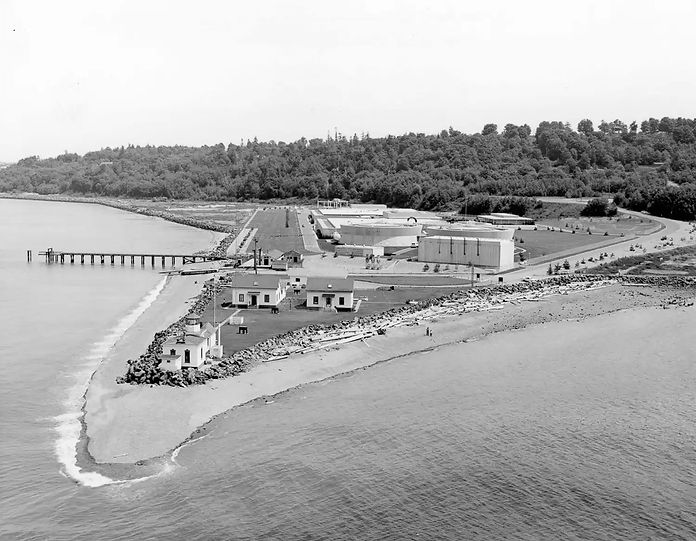
Fig. 1. West Point Lighthouse in 1969.
Courtesy of Historic Structures.
The 1974 report documented the same erosion patterns, noting that the South Bluff eroded far more rapidly than the North Bluff because it takes the full brunt of winter storm wind and waves. Portions of the upper South Bluff were retreating 10 to 30 feet over a span of two decades. North Beach eroded much more slowly because the shoreline north of West Point is partly sheltered. The report described the coastline not as a fixed landform but as one that is constantly changing, and at a noticeable rate (3).
Indigenous land use
Coast Salish peoples have inhabited the Puget Sound region since time immemorial, thriving on its abundance of natural resources and developing sophisticated technologies for harvesting and managing food. While this brief overview cannot capture the full depth of Indigenous history in Magnolia, it highlights how Indigenous communities both shaped and were shaped by the land over thousands of years.
Archaeological evidence at West Point shows that 4,500 to 3,500 years ago, Coast Salish peoples gathered shellfish along the rocky beaches. They later shifted toward harvesting clams as the sandy beaches built up over time. Around 1,100 years ago a major earthquake produced a tsunami that buried the beach, and once the shoreline stabilized the site was used again on slightly higher ground (4).
Throughout the Puget Sound region, Coast Salish peoples relied heavily on native plants for tools, shelter, food, medicine, and ceremonial use. Western red cedar was among the most important species. Its wood was used to build canoes and other boats, houses, boxes, and household tools. Cedar bark was processed for clothing, cradle linings, and towels, while roots were used in basketmaking, and charcoal was used to treat canoe paddles.
Other plants also played essential roles. Skunk cabbage roots were prepared as a medicine to ease childbirth. Stinging nettle treated rheumatism and colds. Orange honeysuckle leaves were steeped in water to make a contraceptive drink, and yarrow treated diarrhea and pain. Berries, including huckleberry, salmonberry, thimbleberry, and blackberry, were also an important food source. Indian plum, Oregon grape, salal, serviceberry, and red elderberry were harvested fresh, dried, or cooked (5).
The distribution of plants like these in Magnolia—then and now—reflects soil patterns shaped by glacial deposits. Moisture-retaining clay soils below the bluffs support alder, willow, and big-leaf maple, while porous sand in upland areas supports drier meadow vegetation (6). Although later logging and military use altered much of the forest, the underlying relationship between soil type and plant communities remains evident.
Together, these patterns demonstrate a long-standing relationship between people and place. The plant diversity and landscape features visible in Magnolia today reflect thousands of years of Indigenous stewardship, adaptation, and ecological knowledge.

Fig. 2. Duwamish west coast canoe with traditional longhouse in background, Cedar River, 1893.
Image source: In the public domain and courtesy of University of Oregon Special Collections (7).
Logging and clearing in Magnolia
By the mid-nineteenth century, Magnolia was covered with a mature conifer forest of Douglas fir, western hemlock, and western red cedar, with an understory of young hemlock, fern, salmonberry, and other shade-tolerant plants (8). Surveyors in 1855 noted fir trees up to five feet in diameter, a sign that the forest had reached its peak stage as part of the Puget Lowland region.
Shortly after European American settlement, everything changed. Logging rapidly cleared the plateau, and land use transitioned to farming and grazing, including dairy herds. This period of intensive clearing interrupted the natural pattern of growth and kept Magnolia in an artificially young ecological stage, as David Williams writes: “Discovery Park is abnormal in that it doesn’t contain this successional progression from Douglas fir to hemlock to cedar. Rather the park mostly presents the earlier stages such as the ‘weedy’ stage of fireweed and Scotch broom and various collections of alder and maple“ (9).
The most significant transformation of Magnolia began in the 1890s with the establishment of Fort Lawton (10). Contractors removed nearly all timber not reserved as ornamental shade trees. By around 1910, approximately 100 acres had been cleared to make way for parade grounds, stables, housing, roads, and military training facilities (11).

Fig. 3. West Point Lighthouse, at the base of Magnolia Bluff, as seen from Fort Lawton. March 26, 1899.
Image source: ”West Point Lighthouse” by Ambrose Kiehl, courtesy of University of Washington Libraries, Special Collections.

Fig. 4. Loggers standing on a springboard in Discovery Park in 1907.
Image source: ”Spring board, 1907” is in the public domain and courtesy of the Seattle Municipal Archives, #170360, Series 5801-07.

Fig. 5. The bicycle path near Fort Lawton that later became Magnolia Boulevard; evidence of logging on both sides. 1900.
Image source: Photo is in the public domain and courtesy of the Seattle Municipal Archives, #29857, Series 5801-01.
Dairy and family farms in Magnolia
After the first wave of commercial logging removed most of Magnolia’s old-growth forest in the late nineteenth century, settlers converted the land into pasture rather than allowing the forest to return. By the early 1900s, small family farms and dairies had become common across the plateau and especially in the low stretch of land later known as Pleasant Valley. In 1917 alone, Seattle was supplied by approximately 1,350 dairies housing an estimated 14,000 cows, producing milk for both direct consumption and condensation (12). While most of these operations lay outside the city limits, Magnolia’s dairy farms functioned as local nodes within this larger system.
Many of the residential lots platted in the 1880s had not been sold, so open land was often used for grazing instead of housing (13). The peninsula remained quiet and semi-rural, and families with modest means took advantage of the cleared ground to raise cows, chickens, and small crops. City dairy inspections suggest these were not marginal or informal operations. Retail dairies supplying Seattle averaged inspection scores of 75.6%, while dairy farms averaged 67.6%, indicating a regulated, monitored system rather than purely subsistence activity (14).

Fig. 6. Pleasant Valley agricultural lands in Magnolia, looking northeast, 1909.
Image source: Photo by Asahel Curtis is courtesy of University of Washington Libraries, Special Collections, PPC048.
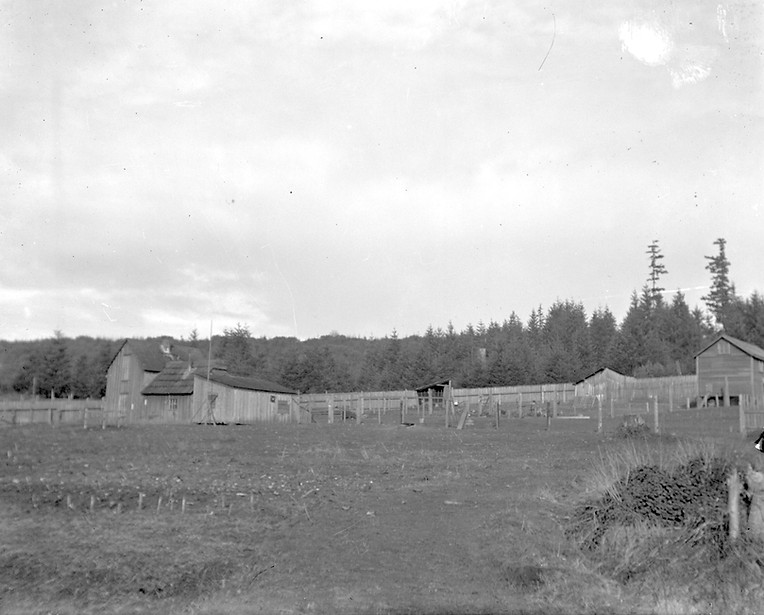
Fig. 7. Farm in Pleasant Valley, Magnolia Bluff, circa 1906–1908.
Image source: Photo courtesy of University of Washington Libraries, Special Collections, SOC16260.
The most well-documented dairy on Magnolia was Merrymount Farm, established by the Hanson family in 1909 (15). The Hansons operated a full dairy herd and produced milk for local delivery, and their farm quickly became one of the main agricultural landmarks in the lightly settled peninsula. For more than two decades the farm occupied much of the open field area in Pleasant Valley and supported the local community at a time when Magnolia remained isolated from the rest of Seattle. Merrymount Farm remained in operation until 1936, when the Hansons sold the land— farming had become increasingly difficult and land values began to rise (16).
Another long-lasting farming operation was the Knutson dairy, later known as West Point Dairy (17). The Knutson family also raised cows and produced milk, serving homes not just in Magnolia but in nearby neighborhoods as well. West Point Dairy is well remembered in community accounts because milk delivery continued even after the dairy itself ceased operating in Magnolia, showing how deeply neighborhood networks of production and distribution shaped daily life before suburban development took hold (18). At a citywide scale, daily milk consumption rose steadily from 18,000 gallons in 1913 to 25,500 gallons in 1917. The increase reflected population growth and per-capita consumption, tying Magnolia’s local pastureland direction to urban demand (19). The dairy fields once associated with the Knutson property are now fully built over, but the farm played an important role in maintaining open land across the lower-elevation parts of Magnolia.
A number of smaller family dairies also appeared across the plateau and in Pleasant Valley during the first decades of the twentieth century. The Volpni family operated one of these small dairies and became known for door-to-door delivery and direct sales to nearby households (20). Other families worked the land quietly without leaving much documentation beyond city directory listings and recollections, but together they contributed to the pattern of scattered pastures that characterized Magnolia’s landscape during this era. These families relied on the same cleared fields created by logging and the reliable water of Wolf Creek and other small streams flowing through Pleasant Valley (21).
Beyond dairy operations, Magnolia supported mixed farming operations that included small livestock and crops. The McGraw family, for example, kept livestock and farmed land on the central plateau near what is now the eponymous McGraw Street (22). Although not exclusively a dairy, the McGraw farm maintained open fields and grazing areas that contributed to the semi-rural identity of Magnolia for decades.
As many as thirteen other family farms in Magnolia appear in early twentieth-century Seattle city directories (23). Most were small, and some may have consisted of only a few cows and a simple barn. Though these farms were not in business long enough to leave archival photographs or formal property records, they formed a distributed network of agricultural households that sustained themselves through a combination of dairy, produce, and eggs (24). Moreover, their presence meant that Magnolia remained primarily agricultural at a time when other parts of Seattle were densifying rapidly. Because these farms were family-run and modest in scale, many closed quietly as economic pressures grew and as suburban development slowly reached the peninsula.
As the dairy era ended, former pastures were subdivided, field roads were turned into neighborhood streets, and barns gave way to houses, schools, and churches. Pleasant Valley, once the agricultural center of the peninsula, became built up with houses, churches, and schools after the Magnolia Bridge opened in 1930 and commuting became easier (25). The Pleasant Valley area roughly corresponds today to the area bounded by 32nd Avenue West and 34th Avenue West, stretching from Magnolia Village north toward the Hiram M. Chittenden Locks.
Although the farms disappeared physically, their legacy remained visible for decades. Large, open fields—created first by logging and then maintained by grazing—prevented the return of dense forest and shaped Magnolia’s ecology well into the twentieth century. These open landscapes later became the sites converted into parks and public open space rather than houses (26). In this way, the farm era did not oppose Magnolia’s later history of conservation but helped make it possible, bridging the period between logging and the military era and ultimately enabling the creation of large undeveloped areas such as Discovery Park (27).
Urbanization and environmental transformation
By the early 1900s, Magnolia was no longer shaped primarily by tides, forests, and the seasonal flow of water. Instead, a series of human decisions, some pragmatic and some ambitious, began to steer the peninsula’s environmental future. As the city expanded and infrastructure crept outward from its downtown, Magnolia’s shoreline, slopes, and uplands all experienced steady, and often irreversible, change.
One of the earliest and most significant human alterations came with the Great Northern Railway in 1893. To run tracks around the peninsula, crews carved directly into the base of Magnolia Bluff and pushed rock and soil into the intertidal zone to form a platform wide enough for the line. That single project narrowed the beach, halted the natural delivery of fresh sediment from the bluff, and set in motion a long period of shoreline hardening (28).
Over the decades that followed, the railway, homeowners, and the city all added various forms of armoring. Riprap, concrete walls, and other barriers helped protect infrastructure, but they also stripped away the upper portions of the beach where forage fish such as surf smelt and sand lance traditionally spawned (29). In a system like Puget Sound, where juvenile salmon rely on shallow, sandy margins as they migrate out to sea, these changes had consequences far beyond Magnolia (30).
Urban development also reorganized Magnolia’s internal hydrology. The landscape’s many natural seeps, springs, and small creeks were gradually rerouted into pipes as homes and streets filled the uplands after the 1920s. Stormwater that used to soak gradually into forest soil or linger in wetlands now moves swiftly across pavements and into underground sewer systems. The result is a watershed that reacts more abruptly to heavy rain. Increased runoff puts extra pressure on Magnolia Bluff, which already sits atop layers of glacial soils prone to sliding when saturated (31). Historical grading, especially during the years Fort Lawton was active, compacted parts of the plateau and altered surface drainage patterns, effects that still show up in present-day erosion and runoff behavior (32).
Residential development later added its own changes. Road cuts, filled ravines, and terraced slopes all modified Magnolia’s natural contours. These changes, though subtle when viewed individually, added up to a landscape with different erosion patterns and a different relationship between uplands and shoreline. The US Geological Survey still identifies Magnolia Bluff as one of Seattle’s most landslide-prone areas, in part because of this cumulative reshaping (33).
All of these transformations—shoreline armoring, drainage changes, and land reshaping—gradually reduced the quality and diversity of habitats that once supported salmon, forage fish, birds, and mammals. Estuarine transition zones and marshy margins, historically rich with life, were among the first casualties of urban expansion (34). Yet Magnolia also holds some of the city’s best surviving examples of pre-urban landscapes. Portions of Discovery Park preserve mature forest, bluff prairie, and quieter drainage patterns reminiscent of an older Magnolia. These remaining natural areas now play an outsized role in restoration efforts, offering a foundation on which future ecological recovery can be built.
Discovery Park since 1974: What has changed, what hasn’t
When the Discovery Park Inventory and Natural History Report was finished in 1974, the park was brand-new and still very much a recovering Army post. The report’s authors described “semi-natural woods and meadows” with vegetation patterns strongly controlled by glacial soils and steep topography, and they stressed how heavily the area had been logged and reshaped before and during the Fort Lawton era. Some basic ecological facts are still true today: that the bluffs were actively retreating, the South Bluff was chronically unstable, and the open meadows and young brushy growth were important for birds but would not persist without management. Invasives such as Himalayan blackberry and Scotch broom were already well established in disturbed areas, though treated more as curiosities rather than as the major management problem they later became. Fifty years later, the forest, meadow, bluff, and beach are recognizable, but almost everything has shifted a notch forward in time. Forests have thickened and gained more conifers, meadows have shrunk and become restoration projects, invasive plants have gone from background to headline, and management has become much more intentional.

Fig. 8. Bluffs at Discovery Park in 1974.
Image source: Photo is in the public domain and courtesy of the Seattle Municipal Archives, #76115, Series 5804-04.
The 1974 report emphasized that most trees in the park “bear witness to repeated logging,“ and that conifers were scattered remnants or plantings, not part of a continuous native conifer forest. By 2001, the city had completed a quantitative vegetation inventory as the basis for the Discovery Park Vegetation Management Plan (VMP). That survey tallied more than 3,000 individual trees in 169 forested plots and confirmed that big-leaf maple and red alder were still the dominant trees, with bitter cherry common and Douglas fir present but secondary. Western red cedar and western hemlock were present in smaller numbers but were increasing (35). The VMP’s guiding principle was to “restore, to the extent possible, the pre-settlement character of the Discovery Park vegetation communities,“ explicitly aligning management with the original 1972–74 master plan vision of supporting native and indigenous growth (36).
Since the VMP was adopted in 2002, hundreds of acres have seen active restoration. Primarily the removal of English ivy, English holly, laurel, and Himalayan blackberry; planting of conifers and native understory shrubs, and, in places like the former Capehart military housing area, full site reforestation. Seattle Parks and Recreation and the Green Seattle Partnership highlight Capehart as 27 acres of new forest and wildlife habitat, designed to mature into a structurally diverse conifer, broadleaf forest (37). Friends of Discovery Park and Green Seattle also point to Bird Alley and adjacent slopes as examples of intensive restoration, where trails have been rerouted to avoid erosion and native wildflowers and shrubs are returning (38).
On the ground, all of this means that areas described in 1974 as thinly wooded early thickets now appear as young to mid-aged urban forest with a noticeable conifer component. Sword fern, salal, and Oregon grape are much more abundant, and it is no longer accurate to say the park “doesn’t contain” the Douglas fir, hemlock, and cedar—those species are now firmly part of the mix, even if the forest is still young by regional standards.
The 1974 report treated the meadows above the South Bluff as droughty grassland dominated by non-native grasses and Scotch broom, recently released from mowing “to include an additional habitat type in the park.“ The authors suggested that this dry, sandy meadow could support introductions from western Washington prairies like Garry oak, ponderosa pine, Idaho fescue, camas, and other species to increase botanical interest and help armor the fragile bluff edge. In the decades since, those meadows have both shrunk and become the focus of active restoration. The VMP designates South Meadow and the “Sludge Meadow” (biosolids application area) as grassland management zones, with explicit objectives to control invasive plants, close social trails, and maintain open-meadow conditions with selective mowing and plantings (39). Birders now know Sludge Meadow as one of the park’s birdiest spots, even as restoration work tries to push it toward a more native grassland rather than a patchwork of non-native pasture grasses and blackberry.

Fig. 9. Sludge pit “meadow“ at the King County waste treatment facility at West Point in 1974.
Image source: Metro Plant sludge pit is in the public domain and courtesy of the
Seattle Municipal Archives, #172099, Series 5801-07.
More recently, prairie and savanna experiments have edged closer to what the 1974 botanists imagined. King County’s wastewater division planted Douglas fir and Garry oak around the reservoir modifications at Discovery Park, noting that both species are well-adapted to the park’s droughty, sandy soils. A “Lizard Haven“ project in the South Meadow has created a small Garry oak savanna patch, explicitly designed as habitat for northern alligator lizards and other meadow wildlife, and led by Green Seattle forest stewards and University of Washington students. The project notes that Garry oak was probably not historically dominant at West Point but may be a climate-resilient choice for maintaining open, structurally diverse habitat on dry soil (40).
While the 1974 report characterized the meadows as weedy and proposed converting them to prairie, current land managers recognize them as uncommon open habitat and maintain them through mowing, invasive-species management, and reintroducing native plants (41).
The 1974 report noted Himalayan blackberry, non-native garden shrubs, and scattered weeds in disturbed areas below the north parking lot and along roads, but the primary emphasis was still on native vegetation patterns and various stages. By 2001, the vegetation inventory counted 134 plant species and found that invasive plants were woven through much of the park. Himalayan blackberry alone was present in about half of all plots sampled, making it one of the most pervasive species in the park. English holly, English ivy, Scotch broom, and several other non-natives also had high “constancy“ values. The VMP calls Himalayan blackberry “a persistent, pervasive species…likely [to] continue to spread in the absence of aggressive management,“ and it devotes entire subsections to blackberry, ivy, and holly control (42).
In response, restoration in Discovery Park over the last two decades has looked very different from what the 1974 authors imagined. Large volunteer programs under the Green Seattle Partnership now focus on cutting and grubbing blackberry, pulling ivy off trees, and removing holly and laurel from the understory followed by dense replanting of native shrubs, ferns, and trees.
Four small wetland pockets were located near the north parking lot, created or accentuated by construction and drainage works, and the park lacked ponds and permanent freshwater, which limited amphibian diversity. Since then, the city has both mapped and, in a few cases, constructed or enlarged wet areas. The VMP identifies a “Utah wetlands zone“ and a “Daybreak Star Pond area“ and objectives to enhance wetland structure, control reed canary grass and other invasives, and use planting to improve habitat for amphibians and birds (43). While Discovery Park is still not a “pond park“ in the way many urban parks are, there are now more intentional freshwater features than the 1974 authors had to work with.
Geologically, during this time, the bluffs were actively eroding, supplying sediment to the beach. Groundwater seeps out between layers of glacial soils, and waves gradually wear away the base of the bluff, causing material to fall and wash down the slopes. They even initiated a study using historic photos and aerial imagery to estimate retreat rates. Newer work has put numbers on that long-term retreat. A recent Magnolia Historical Society story on geology by Bill Laprade summarizes that, at Discovery Park, the North Beach and South Beach bluffs have retreated on the order of about 1 inch and 2.6 inches per year respectively over the last 16,000 years, with rates several times higher if you look only at the last 4,000 years when sea level has been near its present position. The retreat happens in bursts, with landslides that move the bluff back up to tens of feet at a time, and the South Bluff and part of North Beach remain among the only unarmored, un-engineered bluffs left in Seattle (44).
Recent monitoring by University of Washington geoscience students has created a modern baseline for bluff retreat at North and South Beach using repeat surveys and LiDAR, essentially continuing the work the 1974 authors hoped to start (45). The basic hazard they described—rapid, episodic bluff failure feeding sediment to West Point and shaping the spit—has not changed. What has changed is the level of instrumentation, mapping, and public understanding of that process.
At the same time, public use of Magnolia’s remaining open land has grown steadily as Seattle's population has increased and as Discovery Park has taken on a regional identity rather than a neighborhood one. When the report was completed in 1974, the park had only recently opened to the public, and the authors approached visitation cautiously, noting potential conflicts between recreation and ecological recovery. Many of the issues they identified as emerging concerns, such as soil compaction, vegetation damage, and the difficulty of allowing natural processes to proceed in heavily used landscapes, have since become defining management challenges rather than hypothetical ones.
Trail erosion provides a clear example. Paths originally intended for light use have widened under heavy foot traffic, exposing mineral soils and accelerating runoff on slopes already prone to landslides. Informal trails have developed where visitors cut corners or seek shoreline access, particularly on steep bluff edges. These off-trail routes fragment vegetation and destabilize soils, especially in areas where the report identified early plant communities as already vulnerable to disturbance. On the bluffs, even small losses of vegetation can contribute to slope failure, linking recreational pressure directly to the erosion that’s typical of Magnolia geology.
Increased human impact has also intensified pressure on areas that appear rugged but are ecologically fragile. Meadows that resemble natural open space are often mistaken for durable landscapes, even though many originated from historical clearing and persist only because disturbance continues. Repeated trampling inhibits shrub and tree establishment, effectively maintaining the park in the “weedy“ stage described in the report. What appears to be preservation in these areas is, in practice, continued interruption of natural recovery.
Beyond physical impacts, growth has renewed political and planning debates that were only just beginning in the 1970s. Proposals to develop portions of the former Fort Lawton site for housing, social services, or institutional uses have periodically resurfaced, reigniting tensions between urbanization and the ecological and cultural value of open land in Magnolia. The 1974 report recognized the site’s unusual scientific and educational importance, even as it remained embedded within an active urban environment. As Seattle’s population has expanded, the question has shifted from whether development might occur to how much ecological loss the community is willing to accept.
Looking ahead
The pressures facing Magnolia are not new, but amplified. The authors of the 1974 report documented a landscape still recovering from military use and warned that recovery would be slow even under ideal conditions. Increased human impact, continued disturbance along trails and bluffs, and recurring development proposals mean that Magnolia’s ecosystems are not merely recovering from past impacts, but continuously negotiating new ones. The landscape remains dynamic, not only because of landslides and erosion, but because continued human use shapes its future as decisively as it has shaped its past.
Lisa Meoli is an environmental historian at Floyd|Snider with more than 25 years of experience researching industrial, commercial, and land use histories. Her work combines archival research and environmental history to better understand how past land uses have shaped local communities. She writes on local and environmental history for the Magnolia Historical Society.
Notes
1. Discovery Park: Inventory and Natural History. Institute of Environmental Studies, University of Washington, 1974. Seattle Municipal Archives, https://archives.seattle.gov/digital-collections/index.php/Detail/objects/232711
2. David B. Williams, “Discovery Park (Seattle) Natural History.“ HistoryLink, 16 Dec. 2015, www.historylink.org/File/11161
3. Williams. “Discovery Park.“
4. Williams. “Discovery Park.“
5. Williams. “Discovery Park.“
6. Discovery Park: Inventory and Natural History.
7. In Greg Lange. “Seattle and King County’s First Non-Native Settlers,“ HistoryLink, 15 Oct. 2000, https://www.historylink.org/file/1660
8. Williams. “Discovery Park.”
9. Williams. “Discovery Park.”
10. Duane Colt Denfeld. “Fort Lawton to Discovery Park,“ HistoryLink, 23 Sep. 2008, https://www.historylink.org/file/8772
11. Williams. “Discovery Park.“
12. Health and Sanitation Report, 1917, Seattle-King County Department of Health and Department of Health Annual Reports, Record Series 1802-G6 Box 2, Folder 3. Seattle Municipal Archives.
13. Louis Fiset. “Magnolia — Thumbnail History,“ HistoryLink, 30 Jun. 2001, https://www.historylink.org/File/3415
14. Health and Sanitation Report, 1917.
15. Health and Sanitation Report, 1917.
16. Health and Sanitation Report, 1917.
17. “Snapshot in Time: Magnolia’s Pleasant Valley,“ Queen Anne & Magnolia News, 21 Oct. 2014.
18. “Magnolia’s Pleasant Valley.“
19. Health and Sanitation Report, 1917.
20. “Magnolia’s Pleasant Valley.“
21. “Magnolia’s Pleasant Valley.“
22. “Magnolia’s Pleasant Valley.“
23. “Snapshot in Time: Magnolia’s Ballfields – A Dairyland,“ Queen Anne & Magnolia News, 3 Mar 2024.
24. “Magnolia’s Pleasant Valley.“
25. Fiset.
26. Discovery Park: Inventory and Natural History.
27. Discovery Park: Inventory and Natural History.
28. David B. Williams. Too High and Too Steep: Reshaping Seattle’s Topography. University of Washington Press, 2015. pp. 118–120.
29. EnviroVision, Herrera Environmental, and Aquatic Habitat Guidelines Program, Protecting Nearshore Habitat and Functions in Puget Sound, Washington Department of Fish and Wildlife, 2010, https://wdfw.wa.gov/sites/default/files/publications/00047/wdfw00047.pdf; J. Johannessen, et al. Marine Shoreline Design Guidelines, Washington Department of Fish and Wildlife, 2014, pp. 1-9–12. https://wdfw.wa.gov/publications/01583
30. Casimir A. Rice, “Biological Effects of Shoreline Armoring in Puget Sound: Past Studies and Future Directions for Science,” Puget Sound Shorelines and the Impacts of Armoring—Proceedings of a State of the Science Workshop, edited by H. Shipman, et al., US Geological Survey Scientific Investigations Report 2010-5254, May 2009, pp. 155–160.
31. Shannon & Wilson, Inc. “Seattle Landslide Study, Seattle, Washington, Prepared for Seattle Public Utilities,” 2000. www.seattle.gov/documents/Departments/SDCI/About/LandslideStudy.pdf; Edwin L. Harp, John A. Michael, and William T. Laprade. Shallow-Landslide Hazard Map of Seattle, Washington, US Geological Survey, Open File Report 2006–1139, https://pubsdata.usgs.gov/pubs/of/2006/1139/
32. City of Seattle Landmark Nomination Form for Fort Lawton, 2005.
33. Michael A. Fisher, et al., “Crustal Structure and Earthquake Hazards of the Subduction Zone in Southwestern British Columbia and Western Washington,” US Geological Survey Professional Paper 1661-C, 2005. https://pubs.usgs.gov/pp/pp1661c/pp1661c.pdf
34. Paul Cereghino, et al., “Strategies for Nearshore Protection and Restoration in Puget Sound,” Washington Department of Fish and Wildlife Technical Report 2012-01.
35. Jones & Stokes. Discovery Park Vegetation Management Plan, 2001.
36. Jones & Stokes.
37. Jones & Stokes.
38. Jones & Stokes.
39. Jones & Stokes.
40. Niall Dunne. "Lizard Haven: Restoring Wildlife Habitat in an Urban Park," Washington Park Arboretum Bulletin, spring 2025, pp.
20–23.
41. Jones & Stokes.
42. Jones & Stokes.
43. Jones & Stokes.
44. Bill Laprade. “The Hill We Call Magnolia: Puget Lowland Geology,“ Magnolia: More Memories & Milestones, Magnolia Historical Society, 2025, https://www.magnoliahistoricalsociety.org/geology
45. Nicole Sarriedine. “Establishing Baseline Monitoring for Retreat of the North and South Beach Bluffs of Discovery Park, Seattle, Washington,“ MESSAGe Technical Report 095, University of Washington Earth and Space Sciences: Applied Geosciences, 2021. http://hdl.handle.net/1773/46897