
History of Lockhaven Marina, Inc.
By David and Jack Hendrickson with Monica Wooton
Dedicated to our father, Ellis.

Fig. 1. Ellis Hendrickson in the Lockhaven Marina office.
Courtesy of the Hendrickson family. Circa 1980.
Lockhaven Marina, Incorporated was established eighty years ago, on July 5, 1946, and the Hendrickson family has been there through it all. Patriarch Ellis Hendrickson spent countless hours managing the development of the investment he had made in 1946. The company started out in boat repair and moorage, adding more facilities and infrastructure as the years went on. The condominiums and apartments that now stand on the Lockhaven property overlook Salmon Bay, the Ballard Locks, and the many boats still moored at the marina.
Formation of Lockhaven Marina
Shortly after World War II, several Seattle individuals began planning a new marina in Magnolia. One was Thomas Rowlands, a graduate of MIT and a professor of naval architecture for many years at the University of Washington. Claude W. Horst was also a naval architect and a friend of Rowland’s. He operated a touring business from the beach on the Magnolia side of Salmon Bay and a dock near where the fish ladder is today. In November of 1945, Rowlands and Horst purchased the first portion of what would become LMI property—some of the land owned by Seattle pioneer Ole Schillestad—for $15,000. In December of 1945, the two business partners purchased additional adjacent property from a Mr. Radford for $11,700. In September 1946, Schillestad sold them more land for $2,000.

Fig. 2. Seattle P-I article about Ole “Shillestad“ and his property near the Locks.
Courtesy of Paul Dorpat. Circa late 2010.

Fig. 3. Ole Schillestad’s property, which would in the main become the Lockhaven Marina, is seen in the center of this 1912 Baist Map. Courtesy of Paul Dorpat.
On July 5, 1946, Lockhaven Marina, Inc. (LMI) was incorporated under License Number 46009. The initial stockholders were Rowlands (109 shares), Horst (108 shares), and Ellis Hendrickson (83 shares). It’s unclear exactly how Ellis became involved; however, it is known that his wife, Ivah, was instrumental in encouraging him to become invested and involved with the marina development. Due to financial issues, Claude Horst resigned from the LMI Board on December 14, 1951 and sold his shares to Tom Rowlands the following year. The 300 total shares were then redistributed equally between Rowlands and Hendrickson.
At this time, the Lockhaven Marina was configured as two portions of land separated by a small marina owned by a Thomas Cubbins. Cubbins’ marina, a slim piece of most likely pie-shaped land that narrowed by the water, consisted of, at least, one floating finger pier, a little land surrounding the two-story farmhouse Ole Schillestad built in 1880—which Cubbins now owned—and a small store at the head of the docks. The western portion of LMI extended from the Cubbins property to the Hiram M. Chittenden Locks. The larger portion of land owned by LMI extended from the east side of the Cubbins property to the western property line of the Time Oil Company. LMI leased a portion of Time Oil property for many years and used it for boat moorage. At the time Ellis joined the company, the property had several houseboats along the shoreline and several tugs moored in the water.
LMI early facilities
The basic infrastructure of the marina was constructed on the main property from 1946 to 1948 and included roads, water systems, docks, a shop facility, an eight-ton jib crane, an office building, and a caretaker cottage (which burned down in the eighties). Ellis, with the help of his sons Jack and David, installed the majority of the water systems, and the main shop building and office building were Navy surplus. The marina was in the business of renting moorage and repairing boats; they employed a bookkeeper and a workforce skilled in wooden boat repair. It also had a store in the office that sold screws, bolts, paint, and more.
Piers C and D were the original covered piers. The outer end of D was covered after the inner covered portion was completed. The inner, or original set of roofs on C and all of D, were portable welding shed roofs purchased as Navy surplus from the Everett Pacific Shipyard. Pilings were driven, and the roofs were barged in and placed on top of the pilings, by Manson Marine Construction. The flat roof areas between the roofs and most of the walkways were installed by outside contractors. Pier B was the last pier built and its construction was contracted out. The initial wiring was installed by Ellis, his brother-in-law Floyd Bartlett, and, while on leave from the Coast Guard, his brother Harold Hendrickson.
The LMI property had existing sheds that housed power equipment for repairing fishing boats and yachts. A structure called “the ways“ was made up of skids for launching the completed boats. Lockhaven Marina also built a marine railway that was adjacent to the sheds and sloped into the water; a winch, which was surplus from a Navy ship, was used to haul boats on the railway. The railway carriage was a flat wooden surface with 12 x 12 wooden keel blocks down the center, and it measured approximately 60 feet long and 25 feet wide. When a boat floated into the sunken carriage and rested on the keel blocks, the boat would be stabilized with vertical boards or gates, adjusted to the width of the boat. This property was accessed by a gravel road off Commodore Way.

Fig. 4. A painting of a boat on the ways by Amy Hendrickson, Ellis’s second wife.
Courtesy of the Hendrickson family. Circa 1975.
A jib crane, with a capacity of about eight tons, was built at the shore end of B dock in the late forties. When boats were lifted out of the water, they would be blocked up in a work area at the end of B dock. In 1953, a shop (now called the B building) was built to support the crane area. In 1959, two stories were added to the structure. The front of the second story was a storage area for the marina. The back portion of the second story was leased for many years as a sail loft, accessible via a wooden stairway from the ground level. The third-floor area was leased to well-known naval architect William Garden. At least two of his designs were built by Jim Goldade at the marina: a sixty-foot motor sailer with a centerboard keel, called Oceana, and a thirty-six-foot powerboat.
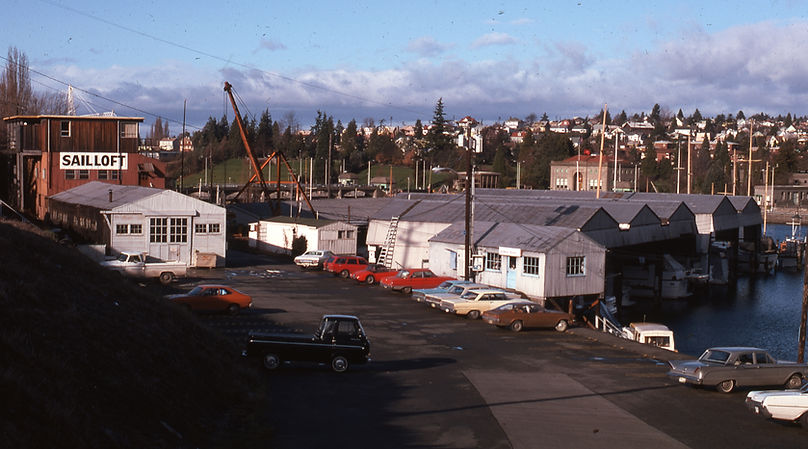
Fig. 5. The boatbuilding and repair shed (left), the jib crane that lifted boats needing repair to the shed (center), the new office where cars are parked (center right), and covered moorage (far right).
Courtesy of the Hendrickson family. Circa 1975.

Fig. 6. The boatbuilding and repair shed.
Courtesy of the Hendrickson family. Circa 1980.
The Cubbins property was finally acquired by LMI in 1965 for $75,000. The marina was then one contiguous parcel extending from the Locks on the west to the Time Oil property on the east.
Condominiums and apartments
In 1976, LMI entered into an agreement with Condominium Builders, Inc. (CBI) to construct a condominium on the upland area of the western portion of LMI property. LMI would retain road access to moorage piers located in front of the condo building. The structures at the ways were removed, including the marine railway—though incidentally, the rails still exist underwater. The A docks were built in 1980, and the condo building was completed in 1982. In exchange for the land, LMI received six of the thirty-six units in the building. LMI sold their units over time depending on the real estate market.

Fig. 7. This office and shed were demolished to make room for an apartment building as LMI diversified its holdings. Also, property was sold to build Lockhaven Condominiums, with unique front-row seats to the Locks’ activities for residents. Six units went to the marina as part of the deal.
Courtesy of the Hendrickson family. Circa early 1990s.
Building into the twenty-first century
In 1994 and 1995, major changes were made to the LMI facilities. The original office building and workshop were removed. A four-story apartment building was constructed to include twelve units—four units on each of the top three floors—along with a new office and twelve storage units on the ground floor. The top two floors of the B building were converted into two additional apartment units. Byron Stoeser, husband of Marilyn (Hendrickson) Stoeser—David and Jack’s sister—was the project manager for the work. Also during that period of time, Bowie Electric rewired the docks. This was a major upgrade; during cold weather, the electrical fuses in the back of the office constantly required replacing.


Figs. 8–9. Then (left): An aerial image taken circa 1945 before the marina was created in this area. The Salmon Bay Bridge is in the top center. Ole Schillestad’s house is the small white two-story house inland, left of the spillway and nearly center in the photo. Time Oil tanks are to the bottom left; Coast Guard buildings are bottom, center front.
Photo courtesy of the Hendrickson family.
And now (right): In 1990, the Lockhaven Apartments in the background left and Lockhaven Condominiums, background right—all built on LMI property—give residents a unique, up-close view of the marina and the goings-on at the Ballard Locks.
Photo by Jeff Wolfe.
Growing up at the marina
Growing up, David and Jack spent many weekends at the marina, often wanting to know when their dad would be finished so they could go home. They sometimes got money to buy a Sunkist Soda at the small store in the Cubbins Marina.
In the early days of preparation for construction of the docks, there was a huge cedar stump located by the left approach to the existing C dock. The brothers tried to burn it, then pull it out with a tugboat. Somehow they finally removed the stump. In the later years, Jack and David actually worked at the marina, cleaning the shop, loading the woodbox for the office’s woodburning stove, or, when a boat was brought up on the railway, scrubbing the bottom of loose anti-fouling paint and then repainting it. Another chore was refilling the Coke machine in front of the office with glass soda bottles. The worst job was cleaning the restrooms and shower located in the west end of the office building.

Fig. 10. The ways: This shows the winch (left) and one of the railway tracks (right), all built by LMI to haul boats in for repairs.
Courtesy of the Hendrickson family. Circa 1960s.
The people who made LMI
Ellis was an electrical engineer by trade, and he continued his career directing designs for military vehicles for Pacific Car and Foundry (PACCAR) while overseeing the marina. The marina also employed staff in boat repair, bookkeeping, and office management.
George Neus and Dave “Jigs“ Alm ran the boat repair business for the Marina for many years. After George left, Jigs’s main assistant was Rod Carpenter. (As a side note, in 1952 the first boat to moor at the marina with a fiberglass hull arrived. Jigs referred to it as a “plastic boat.“) When Jigs retired in the mid-fifties, the boat repair business passed to Jim Goldade, who later worked in the Seattle area as a marine surveyor. Then, Jim Raird operated the business as “Marine Service Center“ before the Donato Brothers took over.
Herman Guernsey, the authors’ maternal grandfather, was office manager in the early 1950s. He was followed by Ethel Lewis, who handled the job for many years.
As one of the original owners, Tom Rowlands remained a central figure to the company for decades. Tom was born in Liverpool, England, and kept many of his British ways. He was an avid boater and spent his summers cruising with friends in British Columbia. For many years he and his wife, Belle, cruised in their motor sailor Betty Belle. He designed and built this boat, which was approximately 45 feet in length. In about 1957, Rowlands purchased an old wooden boat in Canada and had it brought to the Marina. He salvaged the hull and added the superstructure. Tusitala was 60 feet long and powered by twin Lister Marine diesel engines imported from England. Professor Rowlands retired from the University of Washington in the early sixties, and in 1963, LMI purchased his 150 shares for $82,000, making Ellis the sole owner. After his retirement, Rowlands moved to Honolulu, and he passed away in 1994 at the age of 96.
In the late 1970s the boat repair business was assumed by Roy Dunbar and Dunbar Marine Service. Roy not only ran his repair business but managed the moorage business and maintained the facilities. Roy eventually relocated Dunbar Marine Service to a new location just east of the Ballard Bridge.
When Ethel Lewis retired as the bookkeeper in 1965, Jim Hesketh took over, only to be fired in 1970 for embezzling funds. At that point, Ellis’s wife Amy assumed bookkeeping duties briefly, followed by Carol Dunbar, Lynda Hendrickson (Jack’s wife) in 1990–2000, and Kaye Bjur until 2003. For many decades at LMI, monthly statements were handwritten and included a “Lockhaven Log“ that provided general information to boaters about moorage at Lockhaven. During the later years of the nineties and aughties, the bookkeeping was computerized, making the monthly statements much easier to complete. Ellis Hendrickson passed away in 1990. In 2000, Brian Bjur, Jack’s son-in-law, took over the management of the marina.

Fig. 11. One sunset view from the Lockhaven Condominiums overlooking the boats on open docks in the Lockhaven Marina and the Ballard Locks.
Photo by Monica Wooton. 2026
Today, Brian Bjur continues the day-to-day management of the marina as LMI prepares to celebrate the company’s eightieth anniversary. LMI serves mostly local boater owners and is currently at full capacity. No new privately-owned marinas have been built in the last ten years in the Puget Sound area. Though new regulations and large publicly- and privately-owned marinas make management and profits for these facilities a bit tougher, these marinas are considered a scarce resource in high demand for those seeking moorage in fresh waters around Seattle.
Jack and David Hendrickson were raised on Queen Anne and both graduated from Queen Anne High School, David the class of ’56 and Jack class of ’59. Both brothers got their college degrees from Washington State University. Jack graduated in civil engineering and business and went on to a Navy career. David graduated in general studies and went on to receive a master's in business. He was a faculty member and business manager at Tacoma Community College before becoming a residential builder. David remains an avid boater to this day in his 80s! Jack now lives at the Lockhaven Condos beside the marina, and the marina is ever in his view!
This story was written because David and Jack were interested in reflecting on the early years of Lockhaven Marina, Inc. and putting into print the various changes that occurred over the years. Their sister Marilyn Hendrickson Stoeser left her LMI shares to her six nieces and nephews in 2009. Currently, the LMI stock is divided equally between David, Jack, and their children.
Authors’ note: This piece was adapted from a 2016 book, “History of Lockhaven Marina, Inc.,“ compiled by David and Jack Hendrickson. Additional information came from interviews by Monica Wooton with Jack Hendrickson and Brian Bjur (January 11, 2026) and Wooton with Lynda and Jack Hendrickson (January 13–14, 2026). Special thanks to Brenda Bryson for providing help with manuscript and photos.