
Growing Up in Magnolia as Father Doug’s Kid Sister
By Terry Douglas
Father Gordon W. Douglas lived most of his life in Magnolia, where he passed away in the summer of 2024 at the age of 81. He was known to tens of thousands of students and their parents as “Father Doug,” having been the revered chaplain at Bishop Blanchet High School near Green Lake for 38 years.
The Douglas Family
To our family, Father Doug was always called “Gordie.” I’m Gordie’s youngest sister, Terry Douglas, one of the five Douglas siblings born and raised in Magnolia. Our father, Dr. Gordon Douglas, had a dental practice up on Queen Anne Hill, just north of the counterbalance. Our mother and father were active members of Our Lady of Fatima Parish. My father was in charge of the fundraising campaign in 1965 that built the now-permanent church—a beautiful, unique, contemporary church in the round, an architectural feat where today’s Roman Catholic Magnolians still worship. I was the first baby baptized at Our Lady of Fatima back in 1952. My family was proud of that and I took it as a badge of honor.

The unique church my father helped realize for Magnolian Catholics; an exterior
architectural rendering of Our Lady of Fatima.
Image source: Courtesy of Archives of the Archdiocese of Seattle, #VR700-0216. Circa 1965.
Growing up in Magnolia
Magnolia was the perfect place to grow up. We never locked our doors and most of the neighbors knew us by name. I would regularly show up on neighbors’ stoops, knowing I would be invited in for a scoop of ice cream or cookies. The neighborhood kids hung out together, and the gang would explore the nooks and crannies and back streets with great delight and freedom. “Be back for dinner!” was our parents’ only request. That gave us plenty of time to hop on our bikes and poke around Fort Lawton, now Discovery Park. We would climb the crumbling cliffs overlooking Puget Sound along the southern and western edges of the park and then slide down to the rocky beach below. I’m surprised we never broke any bones. Come summertime we’d pick wild and invasive Himalayan blackberries that shot up on long thorny vines and ripened in early August. Our intention was always to collect enough for blackberry pies, but we ate most of the juicy berries before we got home. I felt free as a bird at the fort. I loved the trails leading through the woods, the meadows dotted with wildflowers, and the breathtaking views of the Olympics, Puget Sound, and Bainbridge Island visible from the high bluffs on the west side of the park. From the bluffs, you could smell the salt water and hear the sailboat sails snap in the wind. Fort Lawton was where I learned to drive, with my brother Gordie at my side. He was the cool-as-a-cucumber, patient instructor. For us, Fort Lawton offered it all: adventure, natural beauty, and an escape into the “wilds” of the park.
When not exploring Fort Lawton, we would head down to the Magnolia Village—to us it was always “the Village”—and go directly to Meredith’s 10 Cent Store.

There was something for everyone at the dime store.
Photo by Ken Baxter. Courtesy of Virginia Baxter. Circa 1960s.
Penny candy was the main attraction for my classmates and me! We would carefully select our penny candy, everything from jawbreakers, Pixy Stix, licorice, bubble gum, wax lips filled with sweet syrup, Necco wafers, and candy cigarettes. We would spend inordinate amounts of time blocking the store’s candy aisle, giggling and digging through all the sweet treat bins. Surprisingly, no one kicked us out of the store, probably because we were wearing our Catholic school uniforms. We were always looking for the best value for our hard-earned pennies. After all, our 10-cent allowance had to stretch for the entire week. It also needed to cover our weekly church envelope collection, and maybe—just maybe—something for our piggy-bank savings
A Catholic education
All five Douglas kids went to Catholic schools. Gordie and my other older siblings, Gail and Joe, attended St. Margaret’s School until Our Lady of Fatima School opened in 1954. My other brother, known to the family as “Frisky,” and I attended Our Lady of Fatima all the way through the eighth grade. The Douglas kids continued our (mostly Catholic) education at Seattle Prep, O’Dea, and Holy Names Academy for high school, followed by Seattle University and the University of Washington.
Our Fatima grade-school classes were large—my first-grade class had 49 students—and the Sisters of the Presentation of the Blessed Virgin Mary ruled the roost. Archbishop Thomas Connolly, the archbishop of Seattle, had invited them from California on special assignment to teach in Fatima’s classrooms. Back then, the nuns wore voluminous black habits, veils that covered their foreheads and ears, sensible shoes, and supersized black rosaries that hung from their belts. The nuns’ rosaries rattled as they walked and kept any misbehaving in check. In class, the girls wore navy blue uniforms, beanies, and saddle shoes. The boys wore salt and pepper corduroy pants and navy blue sweaters. When it rained, as it did regularly in Seattle, there was an ever-present smell in the classroom from the wet wool of the uniform sweaters both boys and girls wore.

First-grade class at Our Lady of Fatima, 1959, with Father Blanchard. The author is fourth from left, second row from the top.
Courtesy of Don DeWeese.

Archbishop Connolly greets Sisters of the Presentation arriving from San Francisco to teach at Our Lady of Fatima School at his request.
Image source: Courtesy of Archives of the Archdiocese of Seattle, #VR900-00614. 1954.
The Sisters were otherworldly to me. I think it was their habits that perplexed and fascinated me at the same time. I remember one morning in class when a wisp of hair slipped from the veil—I was stunned. Up until then I didn’t know they had hair. On another occasion, I vividly remember how shocked I was when I spotted a Fatima Sister shopping in the produce section at the Albertsons in the Village. I ran out of the store shaken at the thought they were mere humans. I rarely saw them outside of the classroom, and they lived a seemingly quiet life in their nearby convent located right on the school grounds. To be fair, even though I was awed by them, I always respected them and their dedication to Catholic education.
Father Emery Blanchard was the founding parish priest at Our Lady of Fatima (1). Everybody loved him because he had such a good heart. As a young teenager, I once called Father Blanchard at about two in the morning. I had been drinking with a girlfriend because we wanted to find out how many beers we could consume before getting drunk before we went on our first dates. Surpassing that mark on my first try, I drunkenly called Father Blanchard and, without giving my name, asked him if I had committed a sin. He said, “It’s two in the morning, no, you did not commit a sin, just don’t do it again.” And with that I said, “Thank you.” He replied, “Terry, you need to go to bed, good night.” So much for my anonymous call.
Gordie’s path to priesthood
Gordie, however, missed out on much of this teenage stuff in Magnolia because he entered Saint Edward minor seminary in Kenmore at the age of fourteen to study to be a Catholic priest. I was only four at the time. I didn’t really know what a seminary was, and I often referred to it as a “cemetery,” not knowing the difference until I grew a bit older.
Gordie knew from the age of five that he wanted to be a priest. In a book he authored called Hey, Father!, he explains: “I must have been born with a priest gene.” He goes on to say:
Most kids go through dozens of career dreams as they grow up, but not me. I never wavered. From my earliest days, I was drawn to the magical and mysterious world of the Catholic Church. I wanted to be in the center of that wondrous world, and I figured the priesthood was as close to the center as I could possibly get—at least this side of heaven. When my friends were outside playing cops and robbers, I was inside playing priest. I preached to my dog, and made communion wafers by compressing bits of Albertsons sandwich bread. (2)
After graduating from Saint Thomas major seminary Gordie was ordained a diocesan priest in May of 1968. As such, he was to serve under the archbishop of Seattle doing mainly parish work. He was part of the largest class of priests in the archdiocese of Seattle. After his ordination, Gordie celebrated his first Mass at Our Lady of Fatima.
.jpeg)
Gordie blessing his parents, Alice and Gordon Douglas, after he celebrated his first Mass at Our Lady of Fatima Hall, May 19, 1968.
Courtesy of the Douglas family.
Gordie’s priestly assignments
Gordie’s first assignment as a young priest was in Longview, Washington. He loved parish life, especially working with young people, and he was named “Father of the Year.” Shortly thereafter, he got a call from his boss, Archbishop Connolly, who said he was transferring Gordie back to Seattle as the new chaplain at Bishop Blanchet High School. Gordie told the archbishop that he really wanted to continue as a parish priest and pastor. The archbishop assured him, saying, “Don’t worry, this is a temporary assignment, I’ll call you when it’s time to transfer.” As Gordie jokingly said, he “never got the call.” Gordie spent thirty-eight years at Bishop Blanchet and absolutely loved it—it turned out to be his calling.
Gordie loved the students, staff, and faculty at Blanchet High School and they loved him. His chaplain’s door at the school was always open and he welcomed all with a smile and a “good to see ya.”

Gordie in his Blanchet office.
Courtesy of Seattle Post-Intelligencer. December 14, 2001.
A natural storyteller
Gordie was a natural storyteller and would capture your imagination with his humor and topical stories. As a voracious newshound, he could blend current events effortlessly with his teachings, sermons, and reflections, all with a great sense of timing.
Here’s an example of a homily he gave called “God Gets Kicked Around”:
There was an article in the paper this Sunday about a conflict in a small Kansas town between the members of a church and the owner of a strip club nearby. The church members had tried unsuccessfully to get the strip club shut down. So, they decided they were going to hold a prayer vigil and ask God to shut it down. During the prayer vigil, a thunderstorm came up and a bolt of lightning hit the club starting a fire that destroyed it.
The owner of the club was told by the insurance company that the lightning that destroyed his club was an “act of God” and acts of God were excluded from his policy. So, the owner, who was an atheist, took the church members to court claiming that it was their prayers that caused this act of God. The church members replied that it wasn’t their fault that his club was burned down because God wouldn’t possibly be so cruel.
The judge, thank God, threw the case out of court, but not without commenting on the irony of such a suit. “Here we have” said the Judge, “an atheist on one hand who doesn’t believe in God who claims God caused his loss; and, on the other hand, we have a group of Christians who deny that God would answer their prayers.” (3)
When I read that story, I got to thinking about my brother’s words, the faith we shared, and how often God gets kicked around and blamed for the holes we dig for ourselves. It’s a good thing that God has a thick skin, broad shoulders, and a sense of humor.
Gordie firmly believed in keeping his sermons and homilies short. He clearly followed Shakespeare’s words from Hamlet, “Brevity is the soul of wit.” He felt if you couldn’t get your point across in under seven minutes, there was a good chance you’d lose your audience. So from time to time, he would put an egg timer on the pulpit, tell folks why, and when it dinged, quickly wrap up his sermon and say “amen.” Gordie told me he always had their attention because parishioners knew his message would be short—and they got a kick out of the “ding.”
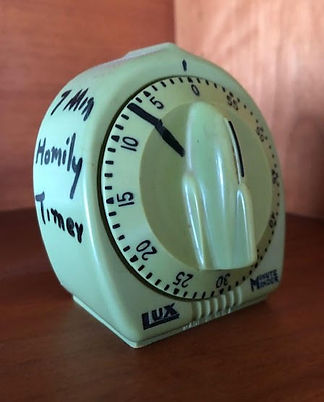
Gordie’s homily timer.
By Terry Douglas. January 2025.
A return to home base in Magnolia
Gordie returned to Magnolia for the last forty years of his life. He took up residence in a small house, originally purchased years prior by the family as an investment, just a few blocks from our childhood home on Viewmont Way West. Gordie loved the home and the Magnolia neighborhood.
The small house had been built during World War II and was located near the Magnolia water tower. It was just perfect for him. He would gladly tackle all home projects with a sense of adventure and glee. During summer breaks, he would often hand-paint the exterior of his home and dive headfirst into home improvement projects. The house had everything Gordie needed, including a den where he built dozens of model ships, a comfy front room that housed hundreds of his favorite books and mementos, and even a fenced backyard for his beloved dogs throughout the years—Isaac, Abraham, and all three dogs named Sarah. He was surrounded by good and kind neighbors. Over his forty years there, the neighborhood slowly changed from small homes to large.

Gordie’s home, after 40 years, was engulfed by larger ones.
Courtesy of Windermere Real Estate, September 2024.
I helped Gordie during his final years as his health gradually declined. Together we made sure he had everything he needed to stay in his home and maintain his independence. I lived nearby and was recently retired, and I was happy to jump in and help my brother in any way—from plumbing to technology issues. Plumbing was clearly not my forte, but one day his toilet handle broke. Gordie assured me I could fix it. I was highly doubtful. Since he only had one bathroom, this was a high-priority fix. By trial and error, mostly error on my part, I ended up installing the handle upside down. We had a good laugh; I then pulled the whole kit and kaboodle out, turned the handle right side up, and called it a day. I drove home feeling pretty smug about my new skill set. He then sent me an email that said, “best plumber I know.”

Terry and Gordie Douglas and Terry’s husband, Gary (left to right), in front of the Kylemore Abbey in Galway while enjoying travels together in Ireland, 2010.
Courtesy of the Douglas family.
We spent some wonderful times together during his final days. We would visit museums, parks, street fairs, you name it—Gordie was up for anything. We particularly enjoyed hanging out on the patio at Maggie’s Bluff. We’d order clam chowder, happily share stories, and take in the ever-changing scenes of the marina and cruise ships with Mount Rainier basking in the background.
Gordie sensed his time here on earth was coming to an end, and he asked me to handle his affairs. It’s always hard to hear a loved one tell you about their final wishes; I squirmed a bit, but he made sure I understood he was “ready to go home.” And go home he did.
Leaving stories to remember
I found Gordie’s reflections, many of which he’d offered every day over the loudspeaker at Blanchet, and snippets of homilies in an old dusty box after he died. I came across them in his back room (along with his egg timer!) as I was clearing out his house. I packed them up and brought them home.
Months after the funeral, I found myself sorting through the still-dusty boxes of reflections and handwritten homilies. I started to read them and I couldn’t put them down. It was like he was in the room with me, once again, talking to me. His writings both inspired me and lifted my spirits. They were filled with wisdom and his trademark humor. I felt compelled to write them down and share them in some way with others. My husband, Gary, encouraged me to have them published. So I did. The book is called Father Doug: The Stories He Could Tell. Here is a selection of his Blanchet reflections and homilies from the book.
Good Morning
I can’t speak for anybody but myself, but when I hear about the death of a loved one, neighbor or friend, I become increasingly grateful for the gift of today and the life God has given me to enjoy this day.
Someone has well said that there are only two kinds of people in the world. There are those who wake up in the morning and say, “Good morning, Lord,” and there are those who wake up in the morning and say, “Good Lord, it’s morning.” Jesus spoke often about the blessing and gift that life is. He had little patience for those who were bored with life and whose lives consequently were unproductive. “Be awake,” Jesus said, “for you know not the day nor the hour when the end will come.”
He tells us not to sleepwalk through the day, but rather to be alive and awake and attentive to the day’s challenges, people and joys. We call today “the present,” because that is precisely what it is “a present.” Good morning, Lord. Amen. (4)
Gordie truly lived in the moment and never took a day for granted. Even during the last years of his life, with all his medical challenges, he was always grateful for yet another day and happy to be part of it. One of his favorite scripture readings, which he shared with me when things got rough, was “I can do all things through Him who gives me strength” (Philippians 4:13). I find myself repeating that scripture passage when my days are challenging, and it helps! Thanks, Gordie!
Talmud
The Talmud is an ancient Jewish book that contains a compilation of their oral laws. It does contain an incredible amount of wisdom.
There is a teaching in the Talmud that I would like to share with those of you who wonder about what value your life has.
The teaching goes like this:
Every person is sent into the world by God with a unique message to deliver, with a unique song to sing, with a unique act of love to bestow.
No one can speak your message, no one can sing your song, no one can offer your act of love. God has entrusted them to you alone!
Therefore, the greatest gift God has given you is the gift of your life; the greatest sin that you can commit is to return that gift to God unopened. Amen. (5)
Gordie always encouraged folks to live to their strengths. I remember him telling me, even if you think an act is insignificant or small, “do it.” He believed that’s why we’re here, to use our God-given gifts and talents to deliver our unique message to the world around us.
A Sacrificial Man
About nine years ago, I attended the funeral of a priest that many of you know, Father Blanchard, who served St. Matthew… back in the early 80s. It was held at Our Lady of Fatima Parish and the church was packed with thousands of people all wanting to pray for and honor this man.
Two weeks later I went to the funeral of another priest, a few years younger than Fr. Blanchard. His funeral was at the small chapel at Mt. St. Vincent in West Seattle. There were only six people there. I got to wondering why one priest’s death so deeply affected thousands and another priest’s death barely touched a half a dozen people? The answer, of course, was obvious. Fr. Blanchard was a sacrificial man. I know this firsthand because he was my pastor growing up as a kid. He was a person, like Christ, who gave his all for the Kingdom of God. The other priest, I also knew well because I worked with him as a deacon. I watched him as he grew more and more cynical about life and people and the Kingdom of God. He slowly began to withdraw more and more until in the end, he was alone in his torment.
Life is about giving and a truly great life is about great giving. In the end that is how others will measure our life and that is how God measures our life.
We believe that those who give sacrificially will reap, as Jesus says in Luke 6, a hundredfold harvest for themselves. (6)
Joy
The Magnificat in today’s gospel proclaims, “My Spirit finds joy in God my Savior!”
Groucho Marx, the great comedian of the 30s and 40s, tells a delightful little story about an encounter he had with a Catholic priest at the railroad station in Chicago. The Catholic priest came up to Groucho, introduced himself and said “Groucho, I just wanted to tell you how much joy you have brought to my life over the years.” Groucho, with that mischievous grin replied “And Father, I want to tell you how much joy you have taken out of my life over the years.”
Joy is a word that is often misused. You see, joy is one of God’s priceless gifts that brings our lives contentment, peace and most important our life’s purpose. (7)
In the homily above, Gordie is referring to Our Lady of Fatima parish priest Father Emery Blanchard. Gordie attended Father Blanchard’s funeral and shared the homily about the pastor who humbly built Magnolia’s Our Lady of Fatima Parish from nothing into something pretty grand.
Father Blanchard was dearly loved by so many of his parishioners, including me. There was something about him that was so pure and honest. He used to hang out on the Fatima playground during recess while reading his daily prayers. We would always run up to him and ask for a blessing, and he gladly complied.
Gordie led a joyful life. He always told me he had no regrets. And if he had to do it all over again, he wouldn’t change a thing. Not bad, huh? He said a joyful life was made up of three pillars: faith, health, and family. That’s a message I hold close to my heart. Whenever I cross the Magnolia Bridge, so many family memories come flooding back.
Terry Douglas compiled a book of her brother’s reflections and homilies, Father Doug: The Stories He Could Tell. She found strength in his words and felt drawn to share his inspiring legacy. She’s now retired after a three-decade career as a financial advisor in Seattle, Washington. Prior to that, she worked as a radio and television broadcaster. Through this publication, Terry hopes you’ll not only enjoy Father Doug’s stories but find some wisdom and inspiration as well. All proceeds from the book go to Gordie’s scholarship fund at Bishop Blanchet High School.
Notes
1. “Mass celebrated for Father Emery Blanchard,” The Catholic Northwest Progress 24 Dec. 1987, p. 5. Washington Digital Newspapers, https://washingtondigitalnewspapers.org/?a=d&d=CATHNWP19871224.2.17.1
2. Father Gordon Douglas. Hey, Father! Grace Filled Moments in the Life of a Catholic Priest. Charis Books, 2001. p. 7.
3. Father Gordon Douglas, p. 97.
4. Terry Douglas, ed. Father Doug: The Stories He Could Tell. Palmetto Publishing, 2025. p. 9.
5. Terry Douglas, p. 10.
6. Terry Douglas, p. 103.
7. Terry Douglas, p. 76.

The cover of Father Doug, the author’s compilation of her brother’s homilies, sermons, and stories, published in 2025. Courtesy of the author.